Ss. Thomas Aquinas and John Bosco: Models of Catholic education
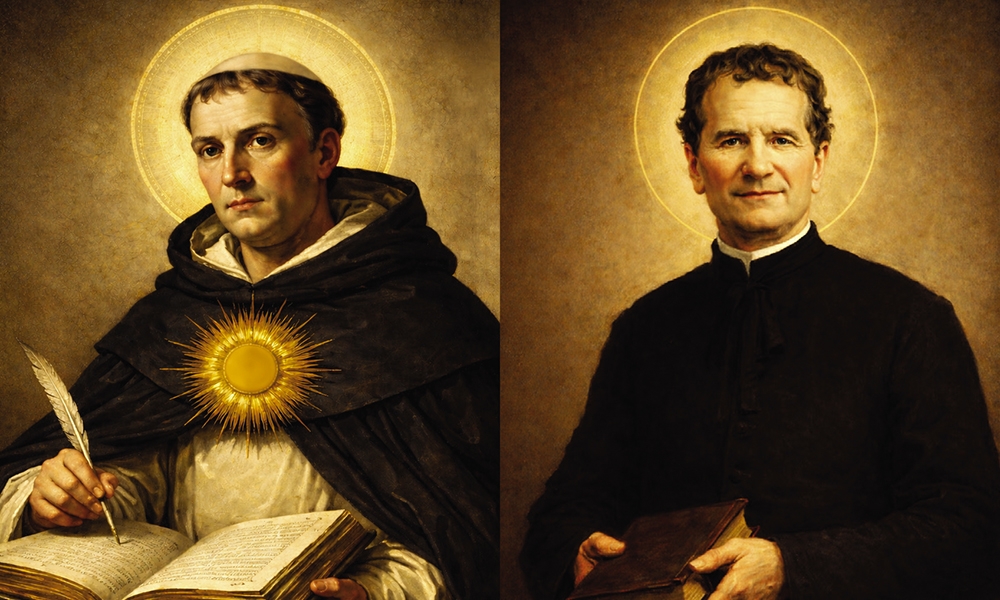
Neatly nestled into the heart of Catholic Schools Week are the feasts of two giants of Catholic education: St. Thomas Aquinas and St. John “Don” Bosco.
These two saints recognized the critical intersection of education and Christian discipleship to effectively form the entire person more perfectly into the image of Christ.
As we celebrate Catholic Schools Week, let us also look at the examples of these two saints as they witness to the Gospel in the development of modern education in Western Civilization.
St. Thomas Aquinas
Thomas was a 13th century Dominican friar, priest, and professor at the University of Paris.
He was a highly influential thinker whose great work, Summa Theologica, remains a pillar of Catholic theological thought and represents the common theological framework within seminary formation.
While most people remember him for his sound logic and harmonization of classical philosophy and Christian doctrine, Aquinas is often overlooked for the profound respect for beauty which he brings to faith.
Along with his doctrinal treatise, Aquinas contributed many hymns and poems expressing praise for the radiance and splendor of God’s beauty.
Aquinas stressed the priority of beauty over truth to deepen the experience of the living God (though he would obviously say both are essential).
His Eucharistic hymns Adoro te devote and Pange Lingua demonstrate how the integration of theology into the discipline of poetry elevates art as a participation in divine beauty.
The glory of God, Aquinas shows us, lifts the whole person into his best form, a perfecting of the person in virtue and grace.
As Aquinas neared the end of his life, he had a mystical encounter with the crucified Christ.
After this encounter, tradition holds that Aquinas began to destroy his volumes to the great dismay of his secretary: “I can write no more. I have seen things that make my writings like straw.”
The importance of this tradition is to show that even our greatest efforts, our purest intentions, or our most virtuous endeavors will pale in comparison to the glory that God has prepared for us.
In our Catholic schools, his legacy persists in the seriousness with which the arts are integrated and protected, not for their own sake, but for the sake of offering our children a profound means by which they can deepen their relationship with God.
We imitate the Creator by expressing our own creativity especially when done in pursuit and reflection of His great glory.
St. John Bosco
At nine years old, young Giovanni Bosco had a vivid dream in which he was surrounded by unruly, brawling, and blaspheming boys.
He tried to correct them with blows and shouting, but the chaos only escalated.
Suddenly, the Blessed Virgin appeared to him and rebuked him gently: “Not with blows, but with meekness and charity must you win these friends.”
He grew to become a priest and school master in Turin, Italy, in the mid-19th century.
Rising from poverty himself, Don Bosco had a great heart for the street boys of Turin.
He took them into his oratory, providing a catechesis that integrated the Sacraments, education, recreation, and prayer.
What set Don Bosco apart as an educator was his unique educational philosophy called the Preventive System.
He expressed to the boys that he felt “perfectly at home in their midst,” stressing reason, religion, and loving kindness as the most critical tools a teacher wields in the education of the tough boys.
Fame of the unique approach to education stretched far and wide.
His system, however, was only applicable where the sacraments were most revered.
When Queen Victoria in faraway Britain sent her court officials to ascertain the secrets of his method, they were shocked to see 500 rough boys quietly reading in the oratory.
When pressed as to how, Don Bosco simply stated they had something which neither the English government nor even the Church of England could provide: frequent access to Confession and Communion.
He founded the Salesian Society in 1859 based on his Preventive System.
In his lifetime, the Salesians erected 250 educational homes worldwide, serving 130,000 students in his educational model. Don Bosco knew that Gospel charity, modeled by Christ Himself, is a necessary means of true conversion.
He entrusted his entire life to the intercession of our Blessed Mother under the title of Mary, Help of Christians.
With her help and his intercession, we seek to cultivate schools of discipleship reliant on the transformative power of Christian charity.
Happy Catholic Schools Week to all of our students, families, teachers, and administrators.
May the grace and peace of Jesus Christ, and the intercession of St. Thomas Aquinas, St. John Bosco, and Mary, Help of Christians, strengthen your wills and enlighten your minds.