Hundreds attend Shroud exhibit in Middleton
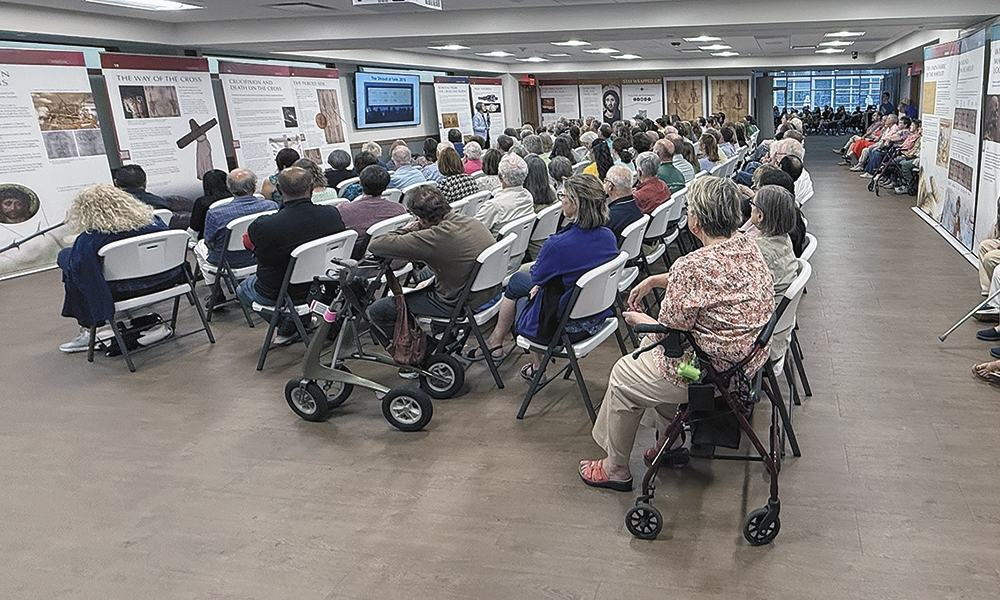
MIDDLETON — A palpable, reverent energy filled St. Bernard Church as a packed crowd gathered for the opening night on May 26 of the weeklong Shroud of Turin exhibit.
Attendees were eager to explore intersections of hope, history, science, and Scripture surrounding the linen cloth and the man of the Shroud.
The traveling exhibit titled “Who is the Man of the Shroud?”, designed by the Othonia Center in Rome, was presented by Pam McCue, who holds degrees in electrical engineering and has more than 30 years of experience working on science, technology, and engineering projects for the U.S. Department of Defense.
Hundreds of faithful traveled from across the diocese to view the exhibit and hear talks from McCue and Bishop Donald J. Hying of Madison.
After seeing the Othonia exhibit in California, Bishop Hying said he wanted to bring the mystery of the Shroud to the Diocese of Madison.
“I was absolutely taken with it, mesmerized by it,” Bishop Hying said. “I asked them if they’d be willing to bring the exhibit here to Madison. They said ‘of course,’ and here we are.”
The exhibit included a replica of the Shroud, a life-size figure of the man and replicas of a crown of thorns, nails, and a Roman flagrum, along with of booklets, prayer cards, and shirts to purchase.
After spending time exploring the exhibit, attendees on May 26 listened to a talk by the bishop on the Resurrection, followed by Mass and then refreshments.
Faith and reason
To frame the dialogue between science and faith, Bishop Hying shared an account from a book written by an atheist scientist who attempted to prove the Shroud as a medieval forgery.
“You come to the end [of the book], and he can’t do it. He can’t prove it’s false,” Bishop Hying explained.
“Because he’s an atheist, he can’t admit what it is, and you’re left with this inconclusion.”
For the bishop, this failed skepticism serves as a compelling base for evidence that the Shroud is what “we have always believed it to be . . . an icon of the Resurrection.”
The challenge of blending scientific discovery with spiritual conviction is something McCue knows well.
“My background is science and engineering, so I had heard about the Shroud in early life, but I heard the radiocarbon dating said it wasn’t 2,000 years old, so I thought it wasn’t worth looking into,” McCue explained.
Then a trip to Jerusalem, where the Othonia exhibit was on display, challenged her original thought.
“It blew me away, the information and the oddness that is so inexplicable,” McCue said.
“At the beginning, my heart said it was real, but I spent two years convincing myself that the science was solid.”
Driven by that conviction, McCue purchased replica components of the display.
She now hauls the exhibit in her own vehicle to schools and churches across more than 10 states, closing in on 100,000 total visitors nationwide.
The photographic negative
The true uniqueness of the Shroud was unlocked in 1898 when Secondo Pia took the first photographs of the Shroud.
The developed negative produced a detailed, anatomically perfect positive image of a wounded man.
Additionally, details of the crucifixion can be seen more clearly, revealing marks and bruises of the crown of thorns, the Cross, falls, and blood and water.
Historically, Jesus Christ is the only recorded human who was both crowned with thorns and crucified, adding to the evidence of the man on the Shroud.
The phenomenon remains unreproducible.
McCue noted that a British filmmaker offered a million-dollar reward to anyone who could artificially create a replica that behaved like the Shroud under photographic inversion. No one attempted the challenge.
“Science holds that it was an energy from the body that marked the cloth on the inside where nothing but the body was,” McCue said.
“That’s the key mystery, and I think it’s a gift for our mind that we really can’t comprehend.”
A help to belief
During the opening Mass, Bishop Hying reflected on the Resurrection narrative across all four Gospels.
He emphasized that while Christian faith is based on the witness of the early Church rather than an artifact, God accommodates human limitations.
“Our belief in the rising of Jesus from the dead is not based on the Shroud, but it certainly helps,” Bishop Hying said.
“As do many things in our Catholic faith help, whether it’s Eucharistic miracles, incorruptible saints, things like the Shroud of Turin, the Tilma of Our Lady of Guadalupe. In all those ways, God appreciates and understands our human nature and provides things for our senses that lead us to a deeper conviction of faith.”
Attendees had the opportunity to walk through panels of information on the Shroud that McCue believes leave them with wonder.
“I think that many people come out of [the exhibit] really thinking that this is a face of Jesus that He left for us. I think the thing that is probably the most significant to people is the signs of the crucifixion that are beyond what you can imagine and its consistency with the Gospels,” McCue said. “I think for people who didn’t understand [the Shroud] before, the crucifixion becomes really real.”
In addition to parishioners, sixth and seventh-grade students at St. Francis Xavier received a presentation from McCue, and students assisted her in demonstrating how the man’s body would have been covered with the Shroud.
Students were “amazed by how science today can help us better understand what took place during Jesus’ Crucifixion and Resurrection,” explained Stacey Eslinger, director of advancement at Holy Cross Parish.
The Shroud exhibit wraps up its display with a key message: “For everyone, the man of the Shroud invites a response to the question Jesus posed to His followers: ‘Who do you say that I am?’”
To learn more about the exhibit and the mystery of the Shroud, visit othonia.org