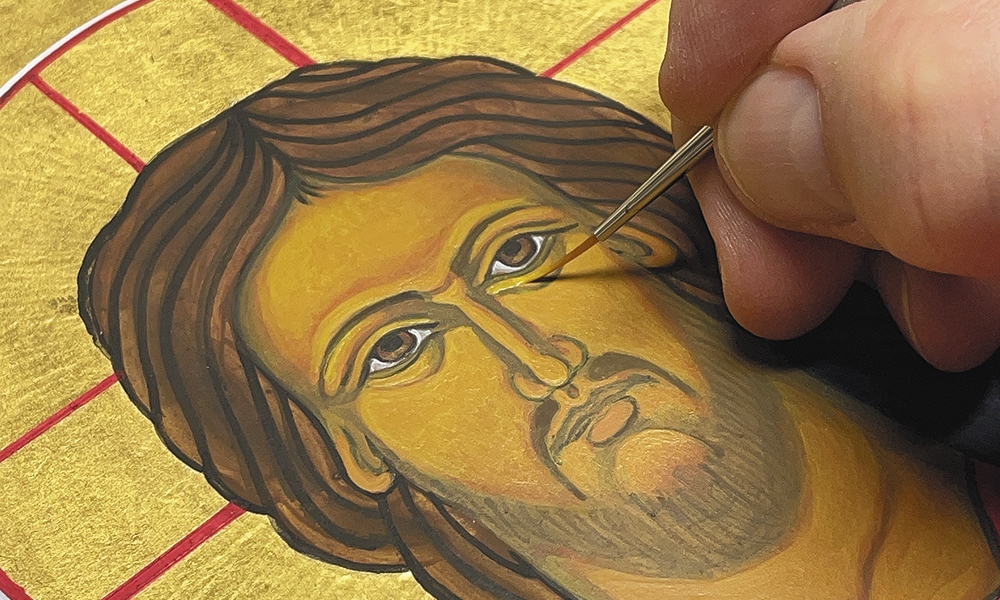
Deacon Roger Scholbrock writes Sacred Heart icon
“If there was a single image or theme that I would draw more than any other, it would be the Sacred Heart. And I’ve painted it, I’ve drawn it, I’ve sketched it ... I just know that I can go to Christ’s Heart and He’s waiting for me there.”
Deacon Roger Scholbrock said these words as he reflected on his history with the image and devotion of the Sacred Heart.
Deacon Scholbrock, who serves at St. Joseph the Worker Pastorate in the southwestern part of the Diocese of Madison, is the sacred artist who wrote the Sacred Heart icon that Catholic Herald readers saw on the front page of the May 14 issue.
As the bishops of the U.S. invite the faithful to draw close to the Sacred Heart this year of the United States’ 250th anniversary, the Catholic Herald asked Deacon Scholbrock to share his story and talk about the process of making the icon.
Sacred art as a calling
“There were three things that I have always known I was going to do, since I was a very, very small child,” said Deacon Scholbrock.
“That’s create artwork, play music, and serve God on the altar.”
He’s done all three. He just retired from a 40-year career in graphic design and illustration. He’s also been a fine artist throughout that time.
“But over time, I became disenchanted with what I was painting, and I was losing my inspiration. Then, when I finally got an opportunity to enter into formation as a deacon, Deacon Chris Schmelzer, director of the Office of the Permanent Diaconate, is a good friend of mine, and when he got close to ordination, I decided to attempt to do an icon of St. Stephen, the first deacon and proto-martyr, for him.”
“Prior to that, I wasn’t a huge fan of the style,” Deacon Scholbrock admitted. “I thought they were kind of rudimentary.”
But that first icon of St. Stephen would draw him into an entirely new field of art — and of prayer.
“When I was doing the research for it, I started to look at the theology behind icons, and how they become like a window to Heaven, and they help us enter into prayer with the people that are being represented. It’s not an idol, but a window into Heaven, which is beautiful and perfect; that’s why there’s a lot of gold leaf that’s used in iconography, because everything there is holy. And when I got into it, I realized that the theology that’s presented in iconography really spoke to me.”
That theology fueled his creative process. He wrote another icon, this time of St. Michael, and gave it to a friend.
“It had a huge impact on him for his spiritual life,” said Deacon Scholbrock. “And I thought, ‘wow, these things really affect people.’”
So he continued to pursue the art form. He found a master iconographer to study under, but due to his work and his duties as a deacon, it was difficult to maintain his studies. He eventually let go of the official training.
“I consider myself a sacred artist because I never finished my apprenticeship as an iconographer. But I continue to study iconography and the finer points of it, so that someday I can become more of what God wanted me to be. Which I think ultimately is what all of us should try to do.”
Writing an icon
The idea for doing an icon of the Sacred Heart started when Deacon Scholbrock heard that Bishop Donald J. Hying was coming to the Diocese of Madison.
Knowing that Bishop Hying would be the one to ordain him, he wanted to find out more and discovered that the bishop — like himself — had a devotion to the Sacred Heart.
“I thought, ‘I’m going to do one of those for him some day.’”
Blessed to help lead a pilgrimage to the Holy Land in 2023, Deacon Scholbrock was able to bring back an unusual souvenir.
“I managed to squirrel a couple of tablespoons of dirt from Jerusalem home in my art supplies.”
He works that dirt into the base layer of his paint, “so that there’s just a touch of the Holy Land with every place that this goes.”
The process of writing an icon begins with initial drawings and value studies, and then he creates an outline. If he’s adding gold leaf to the icon, that goes next, and then he blocks in the darkest base colors. After that, he works his way through to the lightest colors.
The iconography process usually focuses on natural materials, and iconography often emphasizes the natural — what God has created — in the image as well.
Hands or faces will be the most blended, while anything man-made, like clothing, will have simpler geometric patterns and be less refined.
There’s a visual distinction between what God created and what man makes.
There are also expectations for how the icon will be laid out. “There are specific proportions, in what they call sacred geometry,” said Deacon Scholbrock.
“There are lines and diagonals and circumferences and just these nice balance of proportions. Because if it’s drawn wrong, it’ll feel wrong. And God created an order in nature when He built it and created it, and people figured that out when they started creating icons.”
Those specific proportions, along with all the other specific elements, might seem rigid. But actually, they bring a sense of calm to the work.
“We don’t want to create necessarily our own original versions, like ‘I’m gonna do it differently than anybody else, and it’ll just be mine!’ Well, it’s not about me. When I paint an image of the Sacred Heart of Jesus, it’s about Jesus. The master iconographer that I worked with told me that the responsibility for me is to create an image that gives people peace, and if you don’t do it the way it’s been done before and proven, you may cause distress in someone’s prayer life. So the artwork should evoke a sense of calm, a sense of peace, a sense of oneness with those that we are asking for intercession.”
That prayerful purpose starts right from the beginning of the artwork’s creation.
“I have a specific prayer space in my studio, where I will pray before I start. I turn on some Gregorian chant. I’ve got a thurifer that I will stoke up with a little bit of incense . . . Then I try to concentrate on whoever it is that I’m trying to create a sacred piece for, I try to keep them in mind as I’m working and making those decisions, that I’m offering my time as a prayer for them.”
That time as prayer is pretty substantial; he estimates it takes 40 to 60 hours to create a piece.
Deep significance
All the specificity of writing icons — from the proportions to the colors to the symbols — creates a language that can be spoken across time and place, including in the eras when most people weren’t literate.
“Everything’s a storytelling.” In a church full of icons, “you can read the Gospels, or you can read the Old Testament, just by looking at the walls.”
The Sacred Heart image that Deacon Scholbrock created for Bishop Hying is rich in meaning.
The letters in the halo, which look to English speakers like O W N, tie back to God’s self-identification: “I am who am.” (cf. Exodus 3:14) Those letters are sometimes in a different order, due to translation differences, but they always indicate God. No saint will have those letters in their halo.
Christ’s name is also present in the image — the IC and XC with wavy lines above them mean “Jesus Christ.” This indicator is especially helpful to modern viewers when looking at early icons, where Jesus was often portrayed younger and without a beard.
In this specific image, Christ’s hand draws the viewer’s attention to His heart as a gentle invitation. Christ’s hand is in a “blessing” position, which indicates His attitude toward the viewer — desiring to love and bless them.
The pose also contains a statement of the truths of the Faith. Jesus’s hand has two fingers together and three in a group. The two symbolize Christ’s two natures, divine and human, and the three stand for the Trinity.
The specific shape of His fingers can even be traced out to represent the IC and XC.
“So He’s saying that He is Christ,” said Deacon Scholbrock.
The rich meaning of this gesture indicates the depth of symbolism that icons have, but their true impact is found in prayer.
Every aspect of an icon is designed to lead the viewer into an encounter with the person pictured. When Christ is pictured, that encounter can be life-changing.
To learn more about enthroning an image of the Sacred Heart in your home, or how to join Bishop Hying for the consecration of the Diocese on Friday, June 12, visit madisondiocese.org/sacredheart.